
The art of Sugar-Free Oleo Saccharum
- Felipe Tarazona
- 5 days ago
- 3 min read

Sucrose (table sugar) is a powerful tool for extracting flavors, but physiologically it's a hindrance in modern cocktail making. Its extremely high calorie content and its ability to trigger severe insulin spikes make it incompatible with today's health-conscious consumer .
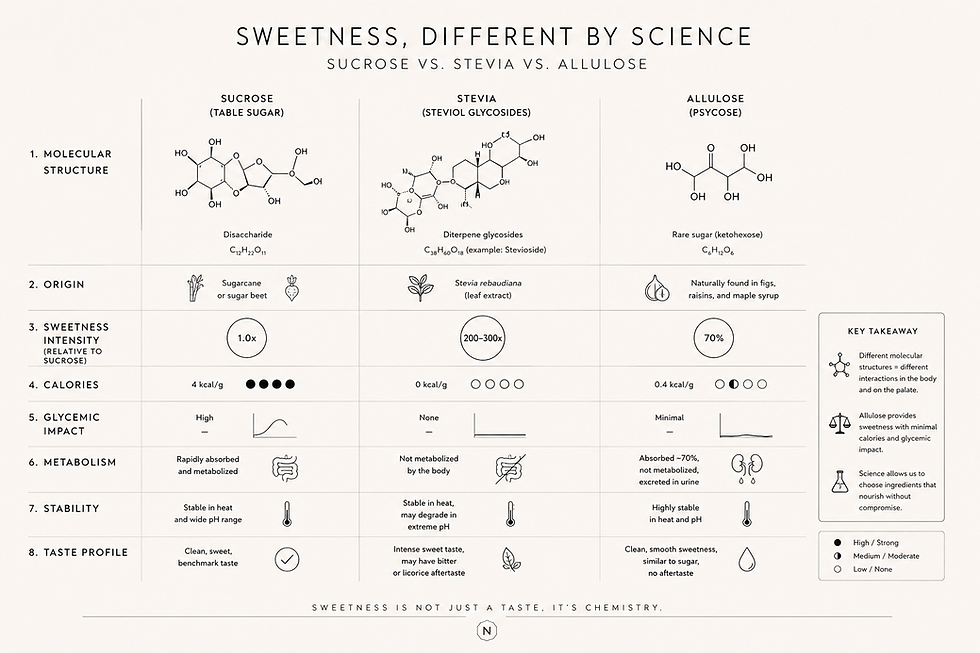
The industry's instinct has been to patch the problem using high-intensity sweeteners , but the result is a sensory disaster. Stevia hijacks the palate with a licorice aftertaste and metallic notes , while erythritol generates a cooling effect (endothermic reaction) that plasticizes and ruins the architecture of any high-end cocktail. We needed an extraction agent that operated mechanically like sugar, but without the metabolic cost.
APPLIED CHEMISTRY
This is where D-Allulose comes in , a rare monosaccharide that occurs naturally in minute quantities in foods like figs. Physically, it behaves almost identically to sucrose, allowing us to take advantage of two fundamental principles: hygroscopicity and osmotic pressure.
Upon contact with citrus peels, allulose powder acts like a molecular magnet. The concentration difference creates such an aggressive osmotic gradient that it ruptures the cell walls of the citrus epidermis (flavedo), violently and efficiently extracting the essential oils, terpenes , and limonene .
The brilliance of this protocol lies in the metabolic bypass . Although D-Allulose has the physical structure to perform osmotic extraction in the bar, the human body lacks the enzymes to break it down. It is absorbed in the small intestine and excreted intact through urine, essentially providing 0 net calories and zero glycemic impact. You get the perfect flavor vehicle, without the side effects.
THE COMPLETE RECIPE
Treat this process with the same precision as an extraction laboratory. The variables must be controlled.
Inputs (Chemical Bill of Materials):
Fresh citrus peels (yellow lemon, orange, grapefruit or yuzu).
Pure D-Allulose powder (without bulking agents or mixtures with erythritol).
Solid State Extraction Procedure:
Cellular Pruning: Peel the citrus fruit with a micro-precision peeler. Strict rule: Zero albedo (the spongy white part). The albedo is loaded with extremely bitter pectins and flavonoids (such as naringin and hesperidin) that allulose will mercilessly extract if left behind.
Osmotic Loading: Weigh your cleaned husks on a precision scale. Add exactly the same weight of pure D-Allulose (1:1 ratio by weight). Mechanically massage the mixture with a muddler for 60 seconds to initiate surface abrasion.
The Vacuum Environment: Transfer the mixture to a vacuum bag and seal at maximum pressure, or use an airtight glass jar by pressing the mixture to the bottom.
Resting Kinetics: Leave the container in total darkness at room temperature (approx. 20°C - 25°C) for 12 to 24 hours. You will see the dry powder transform into a thick, glossy syrup.
Kinetic Warning (The Amateur's Mistake): NEVER apply heat to "speed up" the process or dissolve clumps. Heat increases the volatility of the lighter terpenes (the citrus top notes) and will permanently evaporate them, leaving you with a flat, cooked syrup lacking olfactory brilliance. Extraction must be strictly thermal-passive.

DOWNLOAD THE TEMPLATE HERE.
REFERENCES AND STUDIES
Food engineering isn't based on barroom opinions; it's based on verifiable, peer-reviewed literature . If you want to delve into the exact mechanics that make this technique possible, here's the real clinical and thermodynamic evidence:
Glycemic response and the "Metabolic Bypass" of D-Allulose: * Study: "Effects of D-allulose on glucose tolerance and insulin response" (PubMed: 33637605). It shows how D-Allulose is excreted without being metabolized and does not trigger insulin spikes, operating at ~0.4 kcal/g.
Reference link: https://pubmed.ncbi.nlm.nih.gov/33637605/
Comprehensive Physiological Context: https://pmc.ncbi.nlm.nih.gov/articles/PMC8467252/
Mechanics of osmosis in plant membranes (Terpene Extraction):
Study: "Osmotic Dehydration... Impact of Processing Conditions on the Kinetic Parameters" (PMC: 11643805). It mathematically explains how hypertonic solutions and osmotic gradients force mass transfer (in our case, water and essential oils) from plant cells to the solute.
Reference link: https://pmc.ncbi.nlm.nih.gov/articles/PMC11643805/
Organoleptic profile of rare monosaccharides vs. Sucralose/Stevia:
Study: "D-allulose, a versatile rare sugar: recent biotechnological advances" (PubMed: 34965808). It details how its molecular weight and chemical conformation deliver 70% of the sweetness of sucrose, completely avoiding endothermic reactions (the cold mouthfeel of erythritol) or chemical/metallic aftertastes.
Reference link: https://pubmed.ncbi.nlm.nih.gov/34965808/

Comments